

- This event has passed.
Book Launch – Without Terminus: untraining an archive by chaun webster
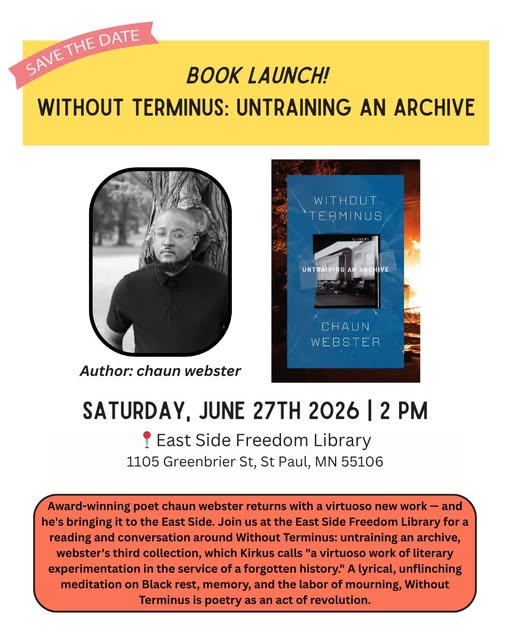
Saturday, June 27, 2026 | 2:00 PM – 4:00 PM | East Side Freedom Library
In collaboration with the Community Digital Repository at ESFL
Join us for an afternoon of reading, conversation, and fellowship with poet and sound artist chaun webster and Black Studies Professor and Pullman railcar researcher, Dr. James Robinson.
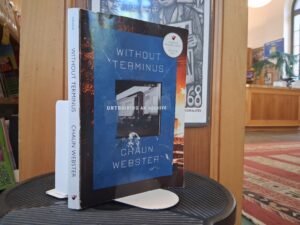
chaun webster’s third collection, Without Terminus: untraining an archive, is a philosophically rigorous and deeply moving work — part elegy, part archival detective story, part visual poem. Drawing on his family’s history as Pullman porters, webster explores Black rest, memory, and the labor that grief demands of the living.
Kirkus Reviews calls it “a virtuoso work of literary experimentation in the service of a forgotten history.” Kao Kalia Yang, author of Where Rivers Part, describes it as “an act of revolution cloaked in the language of poetry, wielding a heart full of courage.”
This is a free event.
We’d love to know you’re coming: register here if you’re comfortable doing so.
It’s never required, and walk-ins are always welcome.
More praise for Without Terminus: untraining an archive
 “Without Terminus tracks chaun webster gone further into that which won’t stop, even for that last, bleak station. In his third work, the poet considers the possibility of Black rest without Black death, the labor that memory demands of the living, and Black life as both fuel and lubricant for the U.S. progress engine. This work demands of Webster new grammars, a hauntology, a means of being without, which is to say a praxis of knowing with grief even that which you can barely mourn. Deeply intimate and tirelessly self-interrogating, Without Terminus is webster at his best. Phenomenal!”
—Douglas Kearney, author of I Imagine I been Science Fiction Always
“A beautifully lyrical rumination on unknowing. For webster, ‘without terminus’ doesn’t mean forever, as in elongated emptiness, but ‘frayed edges’ as a reclamation and new space, the limits as haven. This book is a marvel, a language and image train to travel with.”
—Victoria Chang, author of With My Back to the World
“Without Terminus is an unflinching document of familial love and the legacy of Blackness in America. It is an act of revolution cloaked in the language of poetry, wielding a heart full of courage.”
—Kao Kalia Yang, author of Where Rivers Part
A Glimpse Inside the Book
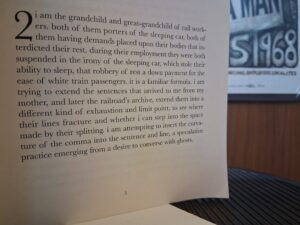 From page 5 of Without Terminus: untraining an archive:
“i am the grandchild and great-grandchild of railworkers. both of them porters of the sleeping car, both of them having demands placed upon their bodies that interdicted their rest. during their employment they were both suspended in the irony of the sleeping car, which stole their ability to sleep, that robbery of rest a down payment for the ease of white train passengers. it is a familiar formula.”
Speaker Bios
chaun webster is a poet and graphic designer living in Minneapolis whose work is attempting to put pressure on the spatial and temporal limitations of writing, of the english language, as a way to demonstrate its incapacity for describing blackness outside of a regime of death and dying. webster’s books include, Gentry!fication: or the scene of the crime (Noemi Press, 2018), and Wail Song: wading in the water at the end of the world, (Black Ocean Press, 2023). Both books were awarded the Minnesota Book Award for Poetry.
Dr. James Alexander Robinson is a native son of Saint Paul, a railroad hub. James Robinson comes from a family of railroad workers. His research specialty is the historical study of Black railroad dining car cooks and waiters, their unions, communities, and families, and on Black railroad workers in general (Pullman Porters, Red Caps). Additionally, James has written on the history of Saint Paul’s Pilgrim Baptist Church. Dr. Robinson is currently the assistant professor of Black Studies within the Ethnic, Gender, Historical, and Philosophical Studies Department at Metropolitan State University. He earned the Interdisciplinary Studies PhD in Black Studies from the University of Iowa, where Dr. Robinson also earned a Master of Arts in History. He holds a Bachelor of Arts degree in Anthropology from Macalester College. Professor Robinson teaches courses on “Forms of Black Studies,” “Black Thought,” “Black Life in Wealth and Poverty,” “Black Intellectual History,” “Black Culture History,” “Black Life and Culture,” and “African Americans in Minnesota.”